Maverick: A Forgotten Ford

For the 1970-1977 model years, Ford produced a "compact car" (in the American sense of the term) called the Maverick.  It was briefly (until the Ford Pinto was introduced) the smallest car in Ford's lineup, and sold well during the 1970 model year as this Wikipedia entry indicates.

Mavericks were available with V-8 motors as well as in-line sixes, so some could be advertised as "muscle cars" and a few were even sold to police departments.  But basically the Maverick's role in the marketplace was as an affordable, utilitarian car.

As for its styling, it was pleasant for the two-door version.  It had a typically thin roof line of its era that smoothly transitioned into a convex sort of fastback.  The sides featured a horizontal character line that bumped over the wheel well openings for added visual interest.  The grille was a nondescript, but functional, egg-crate design set above bumpers that strike us today as flimsy (they were beefed-up in later years to conform to government regulations).

Four-door Mavericks were less attractive, perhaps because they were slightly longer and had a bustle-back trunk area.

Gallery

Maverick two-door - 1972
This is one of the earlier two-door models with the sketchy front bumper.

Maverick four-door from around 1975
A view of a four-door Maverick with a two-door in the background.  Despite what this advertisement's headline wants us to believe, the Maverick was never a luxury car.  Note the stronger bumpers on these later Mavericks.

Profile views of 1973 Mavericks
This catalog fragment is included to illustrate the roof line variations.

New Wine in Old Bottles: Postwar Delahaye 135

By historical accident, World War 2 coincided with a major change in automobile style.  Prewar, cars were given the appearance (and to some extent, the actuality) of streamlining.  That is, they were far more rounded-looking than cars of 1930.  Stylists for mass-market manufacturers were poised to take the final evolutionary step when the war intervened and production essentially ceased.  That step was the realization of the "envelope" body where fenders were merged into the main part of the automobile, no longer being distinctly separate elements.

Once the war ended and production resumed, a few car makers such as Studebaker quickly replaced facelifted prewar models with entirely new designs featuring flow-through front fenders or, in the case of the new Kaiser-Frazer company, slab-sided "pontoon" fenders where the front and rear fenders disappeared into a single element.

The ideal situation, styling-wise, was to have a totally new body.  But this wasn't always feasible financially, so flow-through or pontoon fenders were imposed on prewar designs that  had proportions unsuitable for the new style; in most cases the older design was simply too tall to carry such fender designs, as can be seen on 1949 Packards.

These problems also were faced by low-volume, high-price makers in Europe, including Delahaye, whose production was largely clad by custom-made bodies crafted by coachbuilding firms.  Thanks in part to French industrial policies that punished luxury car builders, Delahaye was never able to produce a totally new postwar car.  So it had to suffer dwindling sales while coachbuilders struggled to keep Delahayes looking up to date despite being based on a body introduced in the fall of 1935, as was the case for its main 135 model.

Gallery

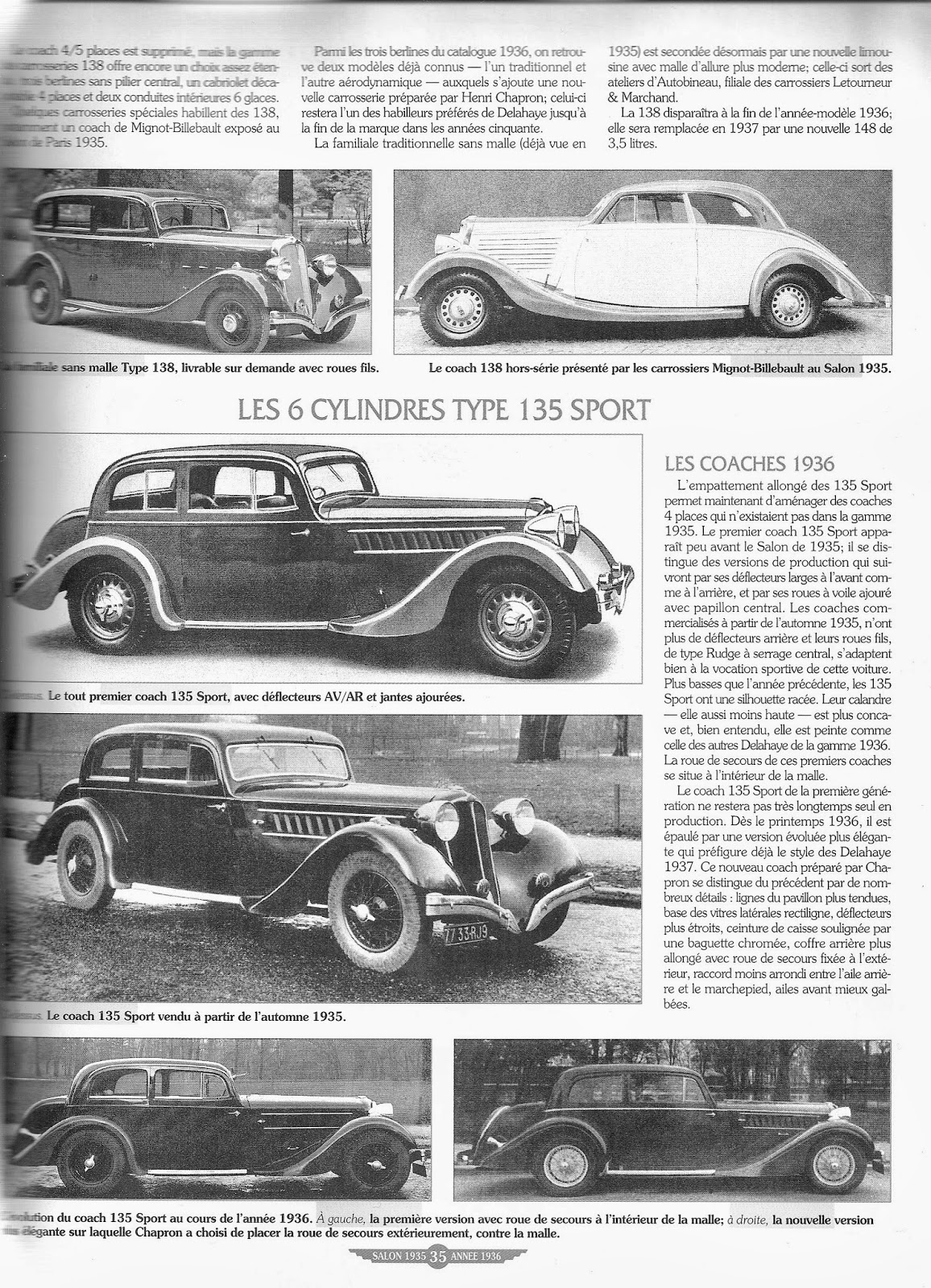
Delahaye 135 Sport models - 1936
Page scanned from Automobilia special historical series, 1936 issue.  The 135 was actually lower and more racy than most prewar cars, so that part of the postwar facelift problem was easier to resolve than was Packard's case.  But the Delahaye featured a very long hood that was fine in the 1930s, but fell out of fashion in the late 1940s, creating its own facelift problems.

Delahaye 135 MS Cabriolet by Figoni & Falaschi - 1938
A fine example of a prewar custom Delahaye 135.

Delahaye 135 M Cabriolet by Graber - 1947
Here is an early postwar custom design on a similar chassis.  From a styling evolutionary standpoint, it could just as easily have been created in 1939.

Delahaye 135 Cabriolet by Pourtout - c.1948
Here we find flow-through front fenders that fall away and join distinct rear fenders, very much in the idiom of Buicks for 1942-48.  The vertical grille and long hood give away its prewar heritage, though the design would not be far out of step for its model year even in America.

Delahaye 135 Coach by Guilloré - 1949
More prewar is this two-door model whose basic body is given a pontoon fender treatment by the same coachbuilder, as can be seen in the images below.

Delahaye 135 M Coach by Guilloré - c.1950
Delahaye 135 M Coach by Guilloré - 1950
These Delahayes by Guilloré are essentially the same aside from the partly decorative engine compartment heat exhaust vent on the side of the dark blue car.  This detail adds a bit of interest to what otherwise is a large, featureless expanse of sheet metal.  The passenger compartment is awkwardly done, perhaps being partly or entirely factory bodywork.  Note the similarity to the passenger compartment of the car shown above: a major difference is how the doors are hinged, and the rear side window shapes might be slight different.  In any case, the slab-sided appearance resulting from pure applications of the pontoon fender style in nearly every case represented design failure.

Delahaye 135 M Cabriolet by Henri Chapron - 1951
Chapron followed the fender style set by Studebaker and General Motors, where the front fenderline flowed back to merge at the top of a tacked-on rear fender. This solution to the problem of slabby sides generally worked fairly well for all who tried it, though this style became less necessary and, eventually, dated-looking as cars got lower and lower in the 1950s.

Classic Postwar Sporty Brit: Sunbeam Alpine Mks 1 & 3

Only 1,852 Sunbeam Alpine Marks 1 and 3 were built during their 1953-55 production run, as this Wikipedia entry mentions.  The Alpine was based on the Sunbeam-Talbot 90 that was produced 1948-1954.

Whereas American styling abandoned the vertical grille towards the end of the 1930s, most British cars did not follow suit until the 1950s, some brands being slower than others in making the transition (traditionalists Rolls-Royce and Bentley did not 'modernise' their grilles until recently).

The 1948 Sunbeam-Talbot 90 along with the Jowett Javelin and the Standard Vanguard, both introduced in 1947, represent England's first echelon of postwar automobiles incorporating "envelope" bodies and other modern styling touches.

Gallery

This seems to be a poster or brochure cover depicting the Sunbeam-Talbot 90 models.  The blue car in the background is the main production version, a four-door saloon.  In the foreground is the drophead coupe version that served as the basis for the Alpine.  Design features include a traditional vertical grille, front fenders that fade away over the door in the manner of 1942 Packard Clippers, and something unusual -- no clearly defined rear fender.  The cars pictured here have open rear wheel housings that reduce the visual bulk of what otherwise would be a large expanse of boring sheet metal (though coverings were available for buyers opting for a smoother appearance).

This is the front cover of a brochure for the Alpine.  I found this on the Internet, but have a copy of this brochure or something similar buried in my collection of automobile sales literature.  Unfortunately, the illustration isn't signed, but it clearly is in the spirit of Frank Wootton.

Another brochure illustration, this showing the smooth curve from the back of the passenger compartment across the trunk (boot) down to the rear bumper.  Look carefully at the image of the Sunbeam-Talbot 90s and note that the shape of the rear of the 90 drophead is less smooth due to the rear passenger seat and the folding top.

Here are photos of Sunbeam Alpines found on the Web.  The green car is a 1955 Mk. 3 and the lower image is of a rare 1953 Mk. 1 with small, racing-type windshields.

I have no serious complaints about the Alpine's styling, especially when taking into account where and when it was conceived.  My main suggestion would be to add a trace of a rear fender, emerging about two-thirds up the side of the car and about half the distance between the door and the rear wheel opening.  This would help lighten slightly the heavy appearance of the rear third of the car.  A much  more costly improvement would be to move the passenger compartment about one foot (30 cm) to the rear.  This would provide a longer hood and better balance to the design which basically was that of the drophead coupe with the rear seat eliminated.

Renault's Not-So Vel Satis Adventure

Renault produced a quirky top-of-their line automobile called the Vel Satis for the 2002-2009 model years including a 2005 facelift.  Sales were around 62,000 cars -- less than 8,000 per year on average.  A short Wikipedia entry on the Vel Satis is here, mentioning that the Latin-appearing name apparently "is a composite of elements of the words Velocity and Satisfaction."  I suppose this is was a fortunate choice, because the words have similar spellings and meanings in both French and English, allowing it to pass undetected by L'Académie française.

The man in charge of Renault styling at the time was Patrick Le Quément, a French-born but British educated designer who was given considerable authority when he was hired in 1987.  He retired in 2009 and began designing boats.  His current project is the establishment of a design school focusing on "sustainability."

Among his goals was the establishment of a new design language for Renault, one that, according to some accounts I vaguely recall, could be identified as French.  And during a period when automobile styling was becoming increasingly internationalized, when cars looked less and less British, German, American and so forth, he did succeed in creating distinctive designs for Renault.

The Vel Satus is an interesting case.  Renault wanted a new high-end model that might compete with Mercedes and BMW.  Yet the resulting car did not embody power, prestige, glamour or very many other traits a potential buyer would expect when shopping for a new luxury car.  The result was poor sales and probably a loss of money on the project.

Gallery

Here are views of the Vel Satis concept car from 1998.  It's more interesting than the production model which dropped every feature aside from the design of the grille.  A styling touch that intrigues me is the juxtaposition of curved surfaces at the rear as seen in the lower photo.  The roof exhibits a strong horizontal-plane curve when seen from above.  This is echoed in a lesser way by the vertical-plane curve at the extreme rear as seen from the side, the downward curve at the rear of the fender line that continues as a roll over the trunk and rear bumper area.  In contrast to these curves is a wedge-shaped front end.  The result is not what I'd call beautiful, but it certainly offers stylists food for thought.

These are images of the initial production Vel Satis, the second and third being factory photos.  The production car is definitely more practical than the concept version, but is chunky and nondescript styling-wise.  No wonder it failed to compete with BMWs and Mercedes.

This is a face-lifted 2005 model.  The most obvious exterior change is the positioning and coloring of the grille bars.  The wheels also differ from the earlier version.

Separated Twins: 2013 Ford Escape and Toyota RAV4

I recently decided that it was about time to replace my 2009 Toyota RAV4 with a restyled 2013 model.  So I began to pay more attention to the '13s when I was out and about.

But I encountered a problem: Many times when I at first thought I was looking at a 2013 RAV4, I was actually seeing a 2013 Ford Escape, a rival compact SUV.  Hence the subject of this post.

Because both cars were restyled for the 2013 model year, it is unlikely that Toyota stole Ford's theme or vice-versa, because the cars were probably under development around the same time.  What Toyota was doing was taking the theme of the 2008-2012 RAV4 design and making it more in line with the current fashion for sharp-edged, somewhat baroque shapes.  Ford, on the other hand, had a rather plain, boxy-looking Escape line for 2008-2012 and wanted to make it more in line with the current fashion for sharp-edged, somewhat baroque shapes.  But Ford seems to have borrowed a number of styling cues from the popular 2008-2012 RAV4 as the basis for its restyling.  In short, both firms were independently trying to do essentially the same thing (update the RAV4 design), so there's little wonder that the resulting designs seem so similar.

Let's take a look.

Gallery

Here is a 2008 RAV4 for reference.  Key design features include (1) a fender line that rises towards the rear, (2) a reverse-slant to the back edge of the the rear side windows, (3) vertical paneling on large wheel opening lips, and (4) a strong character line and indentation along the lower edge of the doors.  Other details such as windshield rake and the slope of the top are conventional responses to wind tunnel derived aerodynamic data.

Here we compare front three-quarter view of the 2013 RAV4 (top) and the 2013 Escape.  The RAV is nearly nine inches (4.5 cm) longer than the Escape, and its wheelbase is only about an inch (3 cm) more, but these differences have little effect on appearance.  Aerodynamically-influenced features aside, similarities include: (1) rising fender lines, (2) strong wheel opening lips, (3) strong character lines on the lower door area, (4) a "shoulder" level character line a little below the side window sills, and (5) wraparound, sharp-cornered headlamp and tail light housings.

Rear three-quarter views show fewer similarities, though both cars follow current fashion in the form of sharp, fussy tail light shapes.  The Escape's rear styling is busier, offering a more baroque appearance than the RAV.